Buying a new home in California means your roof comes with a rulebook. Since 2020, the state has required solar panels on nearly every newly built single-family home. If you are shopping for new construction in the Bay Area, solar is a standard feature rather than an upgrade.
That raises real questions. How much solar do you actually get? Does it cover your whole electric bill? What happens if your lot does not get much sun?
Here is what we will cover:
- What Title 24 actually requires and who it applies to
- How much solar comes standard on a new home
- What the mandate adds to your home’s cost
- Why battery storage matters more under NEM 3.0
What Is California’s Solar Requirement for New Construction?
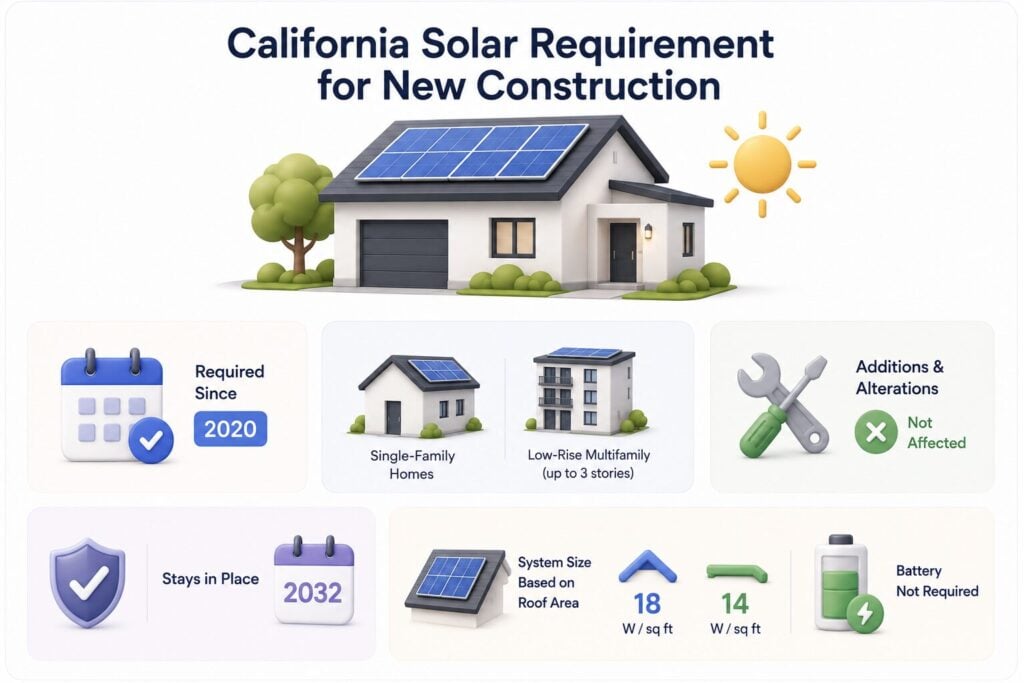
California has required solar panels on new single-family homes since January 1, 2020. The rule comes from Title 24, the state’s building energy code, enforced by the California Energy Commission (CEC). It is a building code requirement tied to permitting, not a suggestion or rebate program.
The current version is the 2025 Energy Code, effective January 1, 2026. It requires:
- Solar PV systems for all newly constructed single-family homes; and
- Solar PV systems for newly constructed low-rise multifamily buildings up to three habitable stories
Additions and alterations to existing buildings are not affected.
Assembly Bill 130 pauses new updates to the Energy Code for residential units until January 1, 2032. That means this code is likely to stay in place for years, rather than shifting again soon.
If you’re comparing new home builders in California, understanding this code matters, since compliance is not optional and ties directly to permitting.
What changed in the 2025 energy code
The 2025 Energy Code sizes solar systems using the home’s Solar Access Roof Area (SARA): 18 watts per square foot for steep-sloped roofs and 14 watts per square foot for low-sloped roofs.
The code does not mandate battery storage for single-family or low-rise multifamily homes. It does require battery-ready wiring for certain single-family homes. This applies to newly built homes with one or two dwelling units and electrical service over 125 amps. The requirement does not apply if a qualifying battery is already installed.
Builders can also earn a size reduction on the required solar system by pairing it with a qualifying battery.
How Much Solar Comes Standard on a New Home?
There is no single fixed system size required across California. The 2025 Energy Code calculates the minimum solar PV size for each home individually, using whichever formula produces the smaller system: the SARA method or Equation 150.1-C.
That calculation depends on three factors:
- Climate zone
- Conditioned floor area
- Number of dwelling units
This means two homes of the same square footage can have different minimum solar requirements depending on where they sit in the state. A home in a cooler coastal climate zone typically needs less solar capacity to offset its electrical use than a similarly sized home in a hotter inland climate zone.
It is worth remembering this is a floor, not a ceiling. The mandate is designed to offset the electrical consumption of the home as if it ran on a natural gas furnace, water heater, stove, and dryer.
Homeowners who add EV charging, a pool, or extra appliances may use more electricity than the minimum system was sized to cover.
Are there exemptions to the solar requirement?
Yes. The CEC allows five exceptions that remove or reduce the solar PV requirement for single-family homes:
- The solar access roof area is smaller than 80 contiguous square feet
- The calculated system size would be under 1.8 kWdc
- The roof cannot meet required snow load standards
- The building was approved by local planning before January 1, 2020, under prior conditions
- A qualifying battery storage system is installed, which allows a 25% reduction in required solar size
Low-rise multifamily buildings follow a similar set of exceptions, with no PV required if the calculated system size is under 4 kW. Builders can also meet the requirement through an approved community solar program instead of installing panels on-site.
What This Means for the Cost of Your New Home
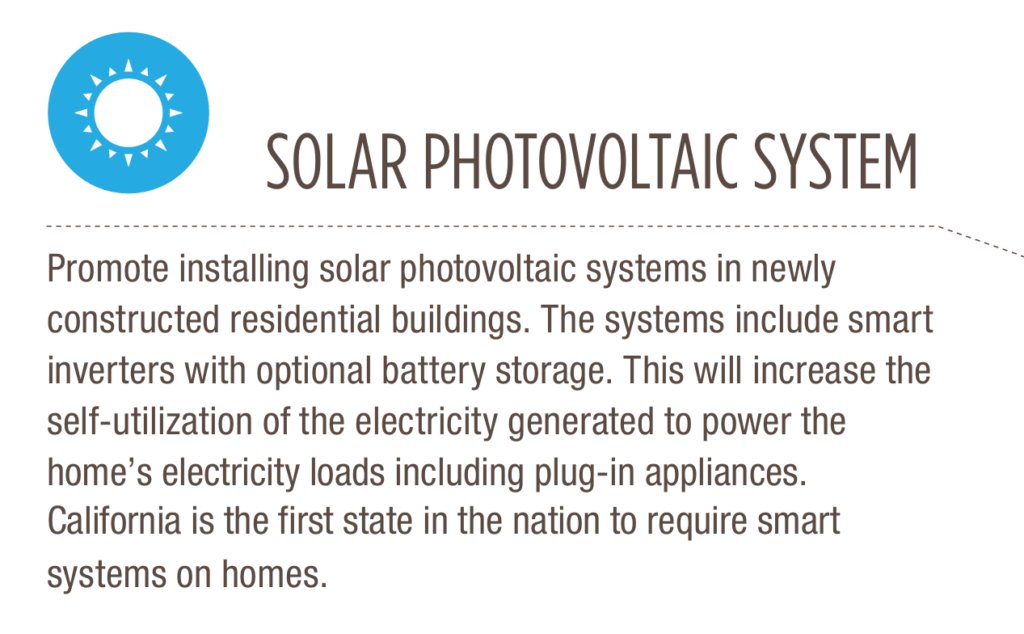
According to a California Energy Commission infographic (PDF), the 2019 standards carry an estimated $19,000 initial cost. That cost is offset by an estimated $9,500 in savings over a 30-year mortgage. This figure covers the full standards package, including solar and other efficiency measures, not solar alone.
Solar compliance is not something a buyer arranges after closing. It gets built into the home during design and permitting, long before move-in day. That means the cost shows up in the home’s price, not as a surprise invoice later.
At AL Homes, this process happens in-house from the start. Solar sizing, permitting, and installation are handled as part of the build, not coordinated separately by the buyer.
Financing the system as part of the mortgage usually costs less per month than paying separately. That is because the expense gets folded into a 30-year loan instead of being paid upfront.
Pro tip: Ask your builder whether solar costs are itemized separately or already folded into your base price. That one question can save you from confusing quote comparisons later.
Book a free consultation to see exactly what’s included in your AL Homes build.
Battery Storage and NEM 3.0: Why It Matters More Now
California’s solar mandate does not require battery storage for single-family or low-rise multifamily homes. But a separate policy shift has made batteries far more valuable than they used to be.
In December 2022, the California Public Utilities Commission adopted the Net Billing Tariff, widely known as NEM 3.0. It applies to any solar interconnection application submitted on or after April 15, 2023.
Industry estimates put the value of exported solar energy under NEM 3.0 at roughly 75% lower than under the previous NEM 2.0 structure. That means selling excess solar power back to the grid pays much less than it once did.
This shift changes the math for homeowners. Under the old rules, exporting extra solar power was often the better deal. Under NEM 3.0, using your own solar power at home, rather than sending it to the grid, tends to save more money.
Battery storage helps homeowners capture and use more of their own solar generation. It is not required by the solar mandate, but for many Bay Area homeowners, it has become the more financially sound choice under current rules.
What to Ask Your Builder About Solar Compliance
Solar compliance affects your electric bill, your home’s future flexibility, and how smoothly your closing goes. Here is what to ask before you sign anything:
- What system size comes standard, and is that the code minimum or something larger?
- Is battery storage included, or is it an upgrade?
- Who backs the warranty on the solar system: the manufacturer, the builder, or both?
- For how many years does that warranty last?
- Can the electrical panel and wiring support future additions, like an EV charger or a bigger battery, without a costly rewire?
Most buyers do not want to manage separate vendors for solar, permitting, and construction. At AL Homes, solar sizing, permitting, and installation happen in-house, from land acquisition through move-in.
If you are weighing new construction against buying an older home, the Trade Your Home program lets you use your current home’s value toward a new AL Home. That means moving once, not twice.
Conclusion
Solar compliance in California is not optional, but it does not have to be complicated either. The 2025 Energy Code sets clear rules for system size, exceptions, and battery-ready wiring, and that code is likely to stay in place through 2032 under AB 130.
For most Bay Area buyers, the real question is not whether a new home will have solar. It is how well that system is sized, installed, and supported after move-in.
At AL Homes, solar is not a separate decision to manage. It is built into the home from the start, code-compliant, permitted, and installed as part of one integrated process. That means no coordinating installers, no chasing permits, and no surprises at closing.
Book a free consultation to see how AL Homes handles solar, warranty coverage, and every other part of your new home build.
FAQs: California Solar Requirement For New Construction
Is solar required on new construction homes in California?
Yes. Since January 1, 2020, California has required solar PV systems on new single-family and low-rise multifamily homes under Title 24, with limited exceptions.
What happens if a builder doesn’t comply with the solar mandate?
Builders must document energy code compliance to get a permit approved and pass final inspection. Non-compliant homes cannot legally proceed to occupancy.
How much does the solar requirement add to the cost of a new home in California?
The CEC estimates the 2019 standards package, including solar, adds about $19,000 upfront, offset by roughly $9,500 in savings over a 30-year mortgage.
Are there exemptions to the California solar mandate?
Yes. Homes with very limited roof space, systems under 1.8 kWdc, snow load issues, or pre-2020 approvals may qualify for reduced or waived solar requirements.