Buying new construction in California comes with real legal protection. Builders must stand behind their work through specific, enforceable timeframes written into the Civil Code, not just a verbal promise.
This article is for general informational purposes only and is not legal advice.
Here’s what we’ll cover:
- What SB 800 (the Right to Repair Act) actually says
- How long each type of coverage lasts
- What is not covered
- What happens if a builder does not honor a claim
What Is California’s New Construction Warranty Law?
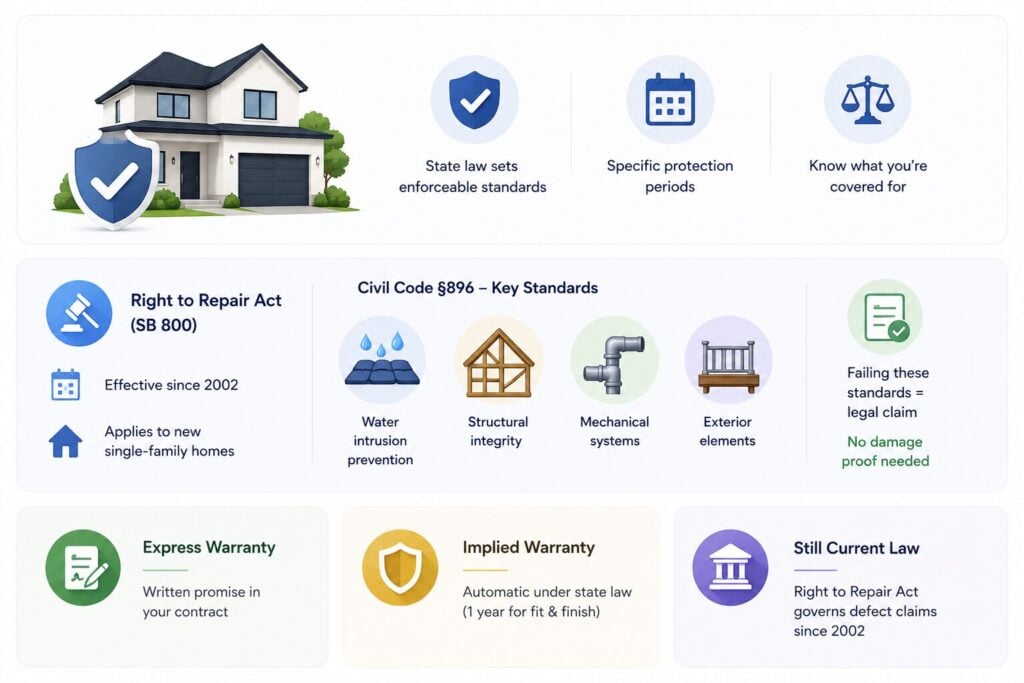
New construction in California is not just backed by a builder’s word. State law sets specific, enforceable standards that every builder must meet. It also spells out how long each protection lasts.
Understanding this law helps you know exactly what you are covered for, and for how long, before you ever need to file a claim.
Right to Repair Act (SB 800 / Civil Code §895 et seq.)
According to Wolff Law Office, California adopted the Right to Repair Act, commonly called SB 800, in 2002. Lawmakers acted after a state Supreme Court ruling denied homeowners the right to sue over defects that had not yet caused damage.
The law applies to homes originally sold as individual dwelling units, according to Civil Code §896.
Section 896 spells out the specific standards a home must meet, including:
- Water intrusion prevention (roofs, windows, stucco, flashing)
- Structural integrity (foundations, framing, load-bearing walls)
- Mechanical systems (plumbing, electrical, HVAC)
- Exterior elements (decks, balconies, siding)
If a home fails to meet these standards, the homeowner has a legal claim. No proof of resulting damage is required.
Express vs. implied warranties
An express warranty is a specific written promise, usually spelled out in your purchase contract. It states exactly what is covered and for how long.
An implied warranty exists automatically under California law, whether or not the builder writes it down. According to Civil Code §900, fit-and-finish items carry a one-year implied warranty if the builder skips the required written one.
For example, a buyer closes on a new home in San Jose. Their purchase contract never mentions a written fit and finish warranty. Six months later, the kitchen cabinets start warping.
Even though the builder never put anything in writing, California law still protects the buyer. The implied one-year warranty applies automatically, so the buyer can still file a claim.
Still current law
Some searches surface SB 800 as if it were a 2021 update. It is not. The Right to Repair Act has governed construction defect claims since 2002, according to Wolff Law Office. Civil Code §896 remains current law today.
What Does a Builder’s Warranty Cover, and For How Long?
California law sets minimum warranty periods for new construction, but the exact timeframe depends on the building component involved. Some protections last one year, others stretch to ten, depending on what part of the home is affected.
1-year: fit and finish
According to Civil Code §900, builders must provide a minimum one-year written warranty covering fit and finish items. This includes:
- Cabinets, mirrors, and flooring
- Interior and exterior walls
- Countertops, paint finishes, and trim
If a builder does not provide this warranty in writing, the law still creates an implied one-year warranty by default.
2-year: systems
California law sets separate timeframes for individual mechanical systems rather than one blanket 2-year period. According to Civil Code §896, plumbing and electrical systems each carry a 4-year window, while items like dryer ducts and untreated wood posts carry a 2-year window.
10-year: structural
Structural defects carry the longest protection under state law. According to Civil Code §941, no action may be brought more than 10 years after substantial completion of the improvement.
This 10-year window is a statute of repose, not a statute of limitations. It runs from the construction date itself, regardless of when a defect is discovered.
What Happens If a Builder Won’t Honor a Claim?
California law lays out a specific process homeowners must follow before filing a lawsuit over a construction defect. This process exists to give builders a fair chance to fix the problem first.
Pre-litigation repair process
According to Civil Code §910, homeowners must send the builder written notice describing the alleged defect in reasonable detail. From there, the process follows a set timeline:
- The builder has 14 days to acknowledge the claim in writing.
- The builder then has 14 days to schedule an inspection, plus up to 40 more days if a second inspection is needed.
- Within 30 days of the last inspection, the builder may offer to repair the issue and set a completion date.
- The homeowner has 30 days to accept the repair offer or request a different contractor.
This process is meant to resolve most issues without a lawsuit. Builders who respond quickly and repair defects properly rarely see a claim escalate further.
When it escalates to a dispute
According to Civil Code §915, if a builder fails to meet these deadlines, the homeowner is released from the pre-litigation process and may proceed with filing a lawsuit.
Why the Builder You Choose Matters More Than the Law on Paper
California law sets the minimum standard every builder must meet, but it does not guarantee how a builder will actually treat you when something goes wrong. Two builders can follow the same statute and still deliver very different experiences.
AL Homes takes a vertically integrated approach, managing all in-house:
- Land acquisition
- Financing
- Design
- Construction
This structure allows for quality checkpoints at every stage of the build, not just a final inspection before move-in.
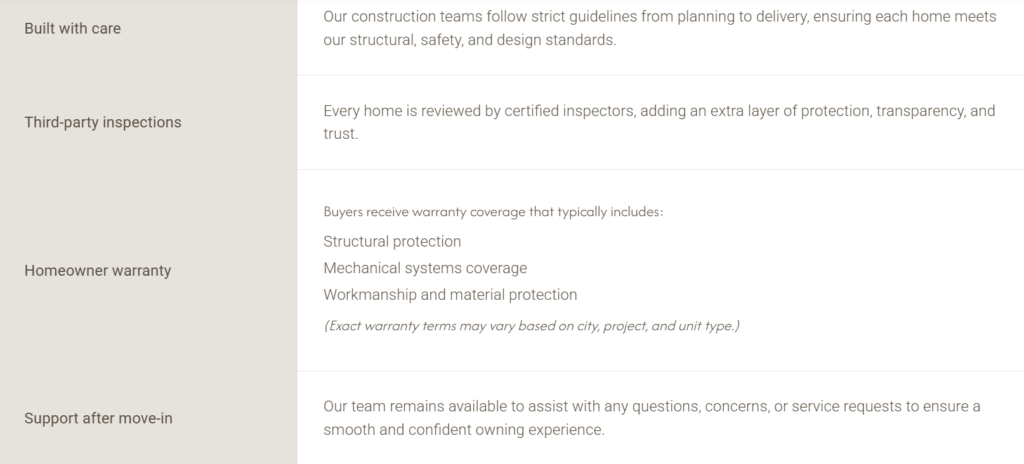
AL Homes backs every home with warranty coverage that typically includes structural protection, mechanical systems coverage, and workmanship and material protection. Exact terms can vary by city, project, and unit type, so buyers should confirm specifics for their community.
Choosing a builder who treats these protections as standard practice, rather than the bare minimum required by law, makes a real difference.
Ready to see this approach in action? Book a consultation with our team.
Conclusion
California’s Right to Repair Act gives new home buyers real, enforceable protection, not just a promise on paper. Warranty coverage varies by component, ranging from one year for fit and finish items to ten years for structural defects. Knowing these timeframes helps you understand exactly what you are covered for, and for how long.
The law sets the floor, but it does not guarantee a smooth experience if something goes wrong. Choosing a builder who treats these protections as standard practice makes a meaningful difference in how issues actually get resolved.
Learn more about what goes into every AL Homes build, or see what to look for when choosing a trusted Bay Area builder.
Note: This article is for general informational purposes only and is not legal advice. Homeowners considering legal action should consult a licensed attorney.