Buying your next home before selling your current one is common in the Bay Area. Most advice treats it as a financing problem, solved with a bridge loan.
Silicon Valley bridge loans currently run in the 9.95% to 10.95% interest range. That adds real cost to an already stressful move.
There is another way. When a builder controls land, design, and construction in-house, your new home’s completion date can match your current home’s sale. That is a structural advantage resale can’t offer, regardless of financing.
This guide covers:
- How homeowners typically buy before selling, and what each option costs
- Why a builder-controlled timeline lowers your risk
- How AL Homes’ Buy Now, Sell Later program works
- Tax and timing factors to know before you decide
- Buying first versus selling first, weighed honestly
The Buy-Before-You-Sell Dilemma in the Bay Area
Homeowners across the Bay Area regularly face the same tough call. Move up to a new home before their current one sells, or sell first and risk months without a place to land. Neither option feels simple, and the wrong choice can cost real money and time.
Why Bay Area buyers face this decision
The typical Bay Area home carries substantial equity, with the regional median sitting around $1.65 million in 2026, according to United States Real Estate Investor. That equity makes buying before selling tempting, but renting in the meantime has gotten more expensive too.
According to McFadden Finch Holdings Company, San Francisco rents rose 22% over the past year, so a temporary rental bridges the gap at a steep cost.
Selling first can mean months in a rental while you wait to close on the next place. Buying first can mean carrying two mortgages if your current home takes time to sell. Either way, timing becomes the central risk of the entire move.
Two paths forward
Most homeowners solve this problem one of two ways.
The first path leans on financing: a bridge loan, a HELOC (Home Equity Line of Credit), or a contingency offer tied to your current home’s sale. Each option carries its own cost and risk, covered in the next section.
The second path removes the guesswork by building with a partner whose construction timeline is predictable from day one. Instead of financing your way around an uncertain resale closing date, you plan around a schedule the builder controls.
That difference matters more than it might seem at first.
5 Ways Homeowners Buy Before Selling
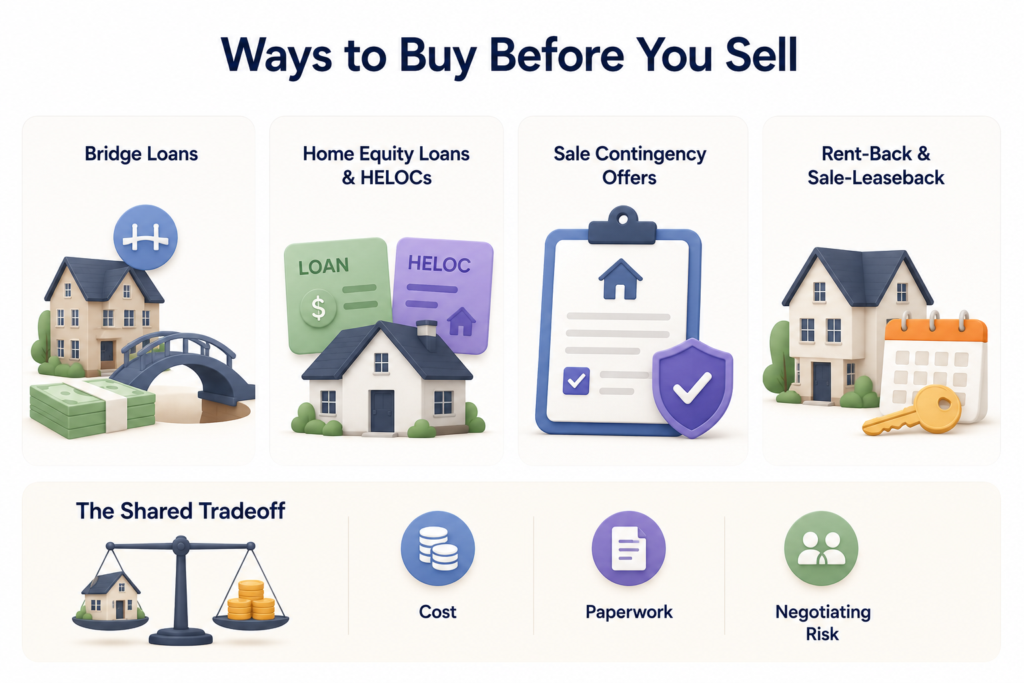
Bay Area homeowners have several options when they need to buy before their current home sells. Each comes with different costs, risks, and tradeoffs worth understanding before you choose one.
1. Bridge loans
A bridge loan is short-term financing that lets you tap your current home’s equity for a down payment. You repay it once your current home sells.
Beyond interest, bridge loans typically carry origination fees of 1% to 3% of the loan amount, according to AmeriSave. You pay these fees upfront at closing, no matter how quickly you repay the loan.
2. Home equity loans and HELOCs
A home equity loan gives you a lump sum against your current home’s equity. A HELOC works more like a credit line you draw from as needed, typically up to 80% to 85% of your home’s combined value and existing mortgage balance, according to The Mortgage Reports.
The actual credit available depends on how much you still owe on your current mortgage.
3. Sale contingency offers
A sale contingency lets you back out if your current home does not sell in time. It protects you financially, but it can weaken your offer.
Bay Area sellers often receive multiple offers and prefer buyers without this condition. That preference can push a contingent offer to the back of the line.
4. Rent-back and sale-leaseback agreements
With this approach, you sell your current home first, then rent it back from the new owner. You stay for an agreed period while you finish your move. Short-term rent-backs are typically priced at the buyer’s daily carrying costs, according to Opendoor.
Longer sale-leasebacks with an investor often net only 78% to 90% of market value at closing. Either way, you become a tenant in your former home, on someone else’s terms.
5. The shared tradeoff
Every option above adds cost, paperwork, or negotiating risk on top of an already stressful move. Bridge loans and HELOCs cost real money in fees and interest. Contingency offers cost you competitiveness. Rent-back and leaseback agreements cost you equity, control, or both.
Why New Construction Changes the Equation
Every option in the last section tries to solve the same underlying problem: a resale closing date you do not control. New construction removes that problem at its root.
Resale timelines are out of your hands
When you buy resale, your closing can depend on a chain of other sales beyond your control. About 14% of transactions tied to another sale experience delayed settlements, according to ListWithClever.
That uncertainty is exactly what pushes buyers toward bridge loans and contingency offers in the first place.
A builder-controlled timeline
Building removes that dependency. A custom build typically takes 12 to 18 months from groundbreaking to move-in, a fixed schedule the builder sets rather than a date tied to someone else’s sale. You know your move-in window from the start, not after a resale seller finds their own next home.
The structural advantage
This is the core difference between financing your way into a resale purchase and building new. A bridge loan or contingency offer manages risk created by someone else’s timeline. A builder-controlled schedule removes that risk instead of pricing around it. That makes new construction steadier ground for a move-up buyer juggling two properties.
How AL Homes’ Buy Now, Sell Later Program Works
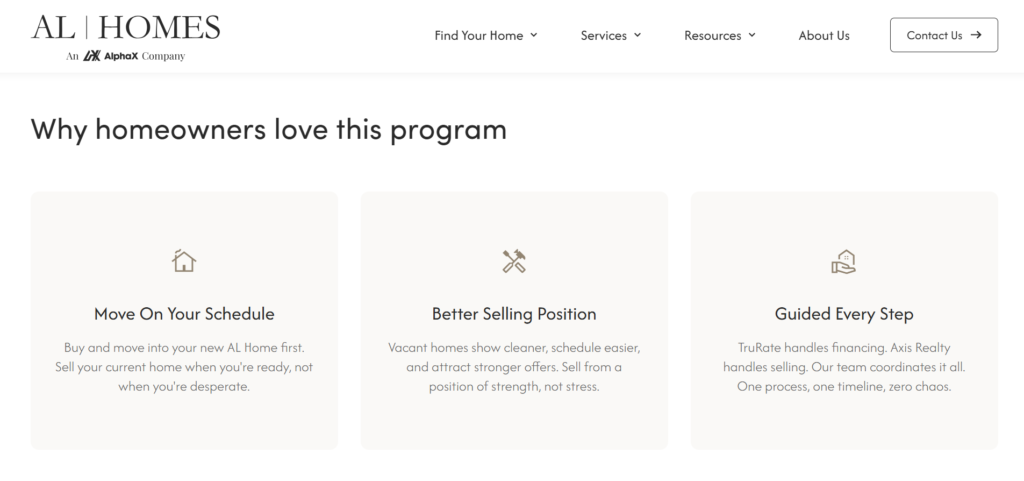
AL Homes built its Buy Now, Sell Later program around the timeline advantage covered in the last section. Instead of financing your way around an uncertain resale closing, you move in on a schedule set from the start.
Apply your equity upfront
The program lets you use your current home’s value toward your new AL Home before it sells. Our lending partner TruRate reviews your finances and current equity to confirm what you qualify for. That means your equity starts working for you immediately, not after a resale closing clears.
Move in first
Once your new AL Home is ready, you move in without waiting on your current home’s sale. You don’t have to rush to close two transactions on the same calendar. You settle into your new home on a date the build schedule sets, not one negotiated with a third party.
Sell on your own timeline
With the pressure of a double move removed, you list your current home when you are ready, not when you are desperate. A vacant home shows cleaner, schedules more easily, and often attracts stronger offers than one you are still living in.
Built in, not bolted on
Our listing partner Axis Realty handles the sale side while TruRate coordinates financing, all inside one AL Homes process. You are not managing a bridge loan from one lender and a listing agent from another. One team coordinates the whole transition on one timeline.
Tax and Timing Considerations to Understand
Buying before selling raises real tax questions alongside the financial ones. The basics are covered below, but it is not a substitute for advice from a licensed tax professional.
Capital gains exclusion basics
Under IRC Section 121, single filers can exclude up to $250,000 in profit from a primary home sale, according to the IRS. Married couples filing jointly can exclude up to $500,000. To qualify, you generally must have owned and lived in the home for at least two of the last five years.
Why timing your sale matters
If your gain exceeds the exclusion, the excess is taxed as a long-term capital gain. A large gain can also raise your total income enough to affect other parts of your return, such as Medicare costs or the taxable portion of Social Security benefits. Selling in a year with other major income changes is worth planning around carefully.
Talk to a professional
Every homeowner’s situation is different, and small details can change the outcome. A tax advisor can walk through your specific numbers before you commit to a sale date. If you want to talk through your options with our team first, book a free consultation.
Buy First or Sell First? What Bay Area Homeowners Should Weigh
There is no universal right answer here. The better choice depends on your finances, your risk tolerance, and how much certainty you need before you move.
The case for buying first
Buying first gives you more control over your next home and removes the pressure of a rushed move. You are not settling for a compromise just to hit a deadline. The tradeoff is possible overlap, carrying two mortgages if your current home takes longer to sell than planned.
The case for selling first
Selling first gives you a clean financial break, with no second mortgage and no bridge financing to manage. The tradeoff is the possibility of temporary housing while you wait to close on your next home. That gap can mean added cost and a second move if your timeline slips.
Building The Simpler Path Forward
Buying before selling does not have to mean bridge loan interest or a rushed sale. Every option in this guide manages risk created by someone else’s timeline. AL Homes removes that risk by controlling the schedule from groundbreaking to move-in.
With Buy Now, Sell Later, you use your equity upfront, move in first, and sell your current home when you are ready. Axis Realty handles the sale, TruRate coordinates financing, and one team manages the whole transition.
Ready to talk through your options? Book a free consultation with our team.
Disclaimer: This article is provided for general informational purposes only and does not constitute financial, tax, or legal advice. Mortgage rates, loan terms, tax rules, and program details can change and may vary by lender, location, or individual circumstances, so always confirm current details with a licensed financial advisor, tax professional, or attorney. AL Homes makes no warranty as to the completeness or current accuracy of the information described here.
FAQs: Buying Before Selling in the Bay Area
Do I have to sell my current house before buying another?
No. Programs like AL Homes’ Buy Now, Sell Later let you buy and move into your new home before your current one sells.
Should you sell your house before looking for a new one?
Not necessarily. It depends on your finances and risk tolerance. Selling first avoids carrying two mortgages but may mean temporary housing.
Is it wise to buy a house before selling yours?
It can be, especially with a predictable move-in timeline. The main risk is carrying two mortgages if your sale takes longer than planned.
How can I avoid paying for two mortgages?
A program with a fixed move-in date reduces overlap risk. You can also shorten the gap by listing your current home as soon as you move.
Where do I live between selling and buying?
With Buy Now, Sell Later, you skip that gap entirely. You move into your new home first, then sell on your own schedule.